

 By
By October 2026 Sky Guide: Saturn, Meteors and Moon Pairings
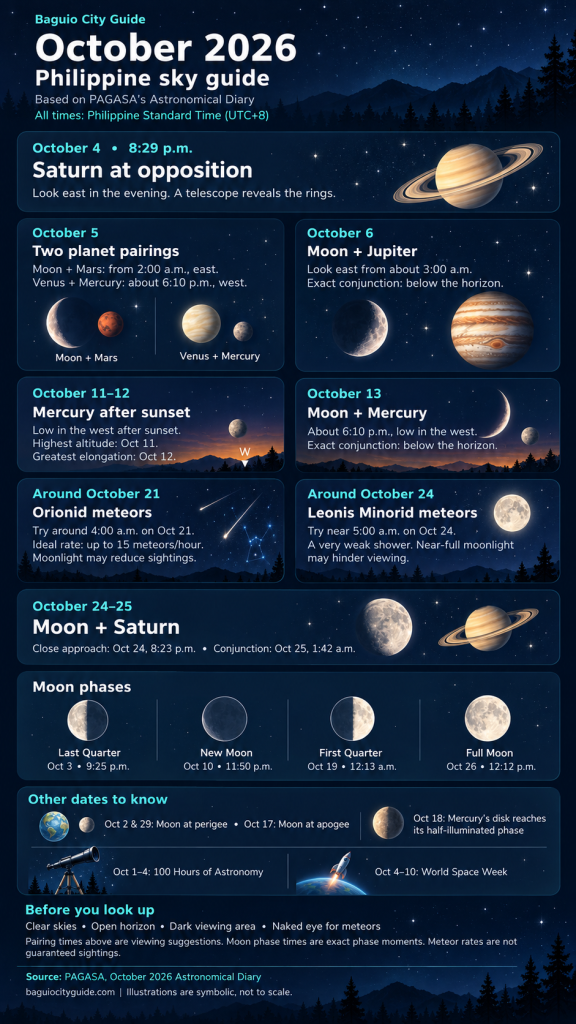
Excerpt: PAGASA’s October astronomical diary lists Saturn at opposition, two meteor showers, Moon and planet pairings, and opportunities to spot Mercury. Here are the dates, viewing times and what these events mean for skywatchers in the Philippines.
October brings several reasons to look up when the skies are clear. Saturn reaches opposition early in the month, Mercury offers an evening viewing opportunity, and the Orionid meteor shower returns as Earth passes through debris left by Halley’s Comet.
The Philippine Atmospheric, Geophysical and Astronomical Services Administration, or PAGASA, has released its Astronomical Diary for October 2026, covering these events alongside the Moon’s phases, changing distance from Earth, and prominent constellations. [1, 2]
All dates and times in this guide are in Philippine Standard Time, or PhST (UTC+8). An event’s exact astronomical time is not always a suitable viewing time. Some conjunctions occur during daylight or while the objects are below the horizon. The viewing suggestions below follow PAGASA’s diary; local horizons and weather will affect what observers can see.
October’s astronomy calendar
| Date | Event | PAGASA’s listed time |
|---|---|---|
| October 1–4 | 100 Hours of Astronomy | Several-day observance |
| October 2 | Moon at perigee, approximately 369,368 km from Earth | 4:52 a.m. |
| October 3 | Last Quarter Moon | 9:25 p.m. |
| October 4 | Saturn at opposition | 8:29 p.m. |
| October 4–10 | World Space Week | Several-day observance |
| October 5 | Moon and Mars conjunction; closest apparent approach | 1:32 p.m.; 2:11 p.m. |
| October 5 | Venus and Mercury conjunction | 11:00 p.m. |
| October 6 | Moon and Jupiter conjunction; closest apparent approach | 6:16 p.m.; 6:23 p.m. |
| October 10 | New Moon | 11:50 p.m. |
| October 11 | Mercury at its highest altitude in the evening sky | No exact time listed |
| October 12 | Mercury at greatest eastern elongation | 6:03 p.m. |
| October 13 | Moon and Mercury conjunction | 4:08 a.m. |
| October 17 | Moon at apogee, approximately 404,573 km from Earth | 6:56 a.m. |
| October 18 | Mercury at dichotomy | 12:55 a.m. |
| October 19 | First Quarter Moon | 12:13 a.m. |
| Around October 21 | Orionid meteor shower peak | No exact peak time listed |
| Around October 24 | Leonis Minorid meteor shower peak | No exact peak time listed |
| October 24 | Moon and Saturn’s closest apparent approach | 8:23 p.m. |
| October 25 | Moon and Saturn conjunction | 1:42 a.m. |
| October 26 | Full Moon | 12:12 p.m. |
| October 29 | Moon at perigee, approximately 364,477 km from Earth | 2:06 a.m. |
The Moon and Mars events appear in PAGASA’s downloadable October diary and its website discussion, although they are absent from the website’s opening calendar table. Distances above are rounded to the nearest kilometre. [1, 2]
Saturn reaches opposition on October 4
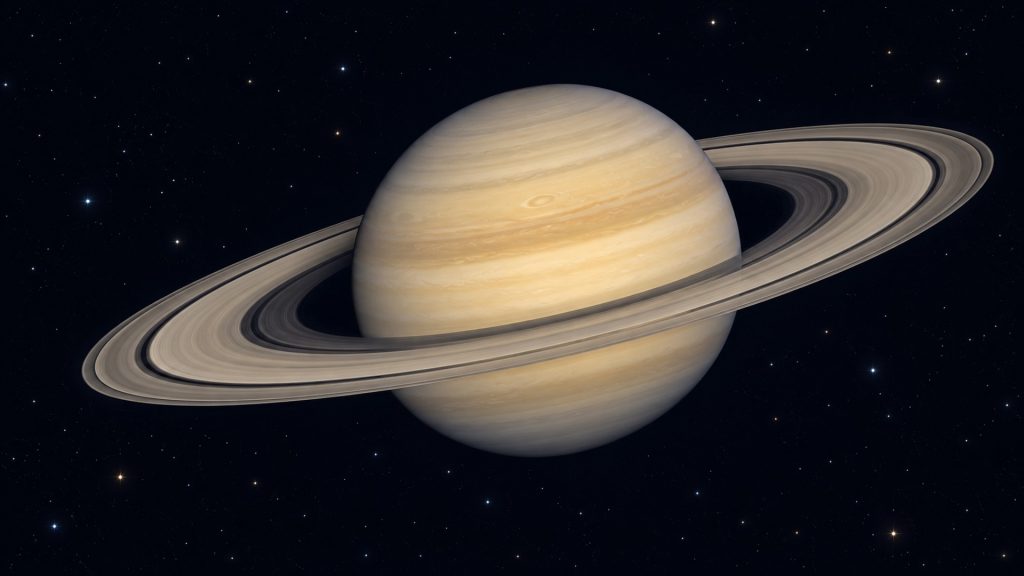
Saturn reaches opposition at 8:29 p.m. on October 4. Opposition means the planet appears opposite the Sun in our sky, with Earth between the Sun and the planet along their orbits.
This makes the period around opposition a useful time to observe Saturn. It is available for much of the night, rather than only during a short window before sunrise or after sunset. PAGASA places Saturn in the constellation Cetus for this event. [1, 2]
Look toward the eastern sky in the evening. As the night progresses, Saturn moves across the sky before setting toward the west. A clear night near the opposition date is also worthwhile; the viewing opportunity does not last for only one minute.
To the unaided eye, Saturn looks like a bright, star-like point. Its rings require optical assistance, with a telescope offering a much better view of their shape and detail. The large ringed planet in photographs will not appear that way to someone looking without equipment. NASA’s observing guidance explains that even a small telescope can reveal details of the rings. [3]
Moon and planet pairings: when to look
A conjunction occurs when two objects share the same right ascension, one of the coordinates used to describe positions in the sky. A close approach, also called an appulse, is when their apparent separation is smallest. These can happen at different times.
The objects only appear near each other from our viewpoint. A Moon and planet pairing does not mean the planet is physically close to the Moon.
| Date | Objects | PAGASA’s suggested viewing opportunity |
|---|---|---|
| October 5 | Moon and Mars | From about 2:00 a.m., looking east |
| October 5 | Venus and Mercury | Around 6:10 p.m., low in the west |
| October 6 | Moon and Jupiter | From about 3:00 a.m., looking east |
| October 13 | Moon and Mercury | Around 6:10 p.m., low in the west |
| October 24–25 | Moon and Saturn | Close approach at 8:23 p.m. October 24; conjunction at 1:42 a.m. October 25 |
The early-morning Moon and Mars view comes before their afternoon conjunction. Likewise, the Moon and Jupiter can be seen on the morning of October 6, while their exact evening conjunction occurs below the horizon. Venus and Mercury will already have set by their 11:00 p.m. conjunction on October 5. [1, 2]
Observers can identify these pairings without a telescope when conditions permit. Whether both objects fit into one binocular or telescope view depends on their separation and the instrument’s field of view. In particular, the Moon and Saturn are separated by about six degrees at their October 24 close approach, so a wide view is useful.
Mercury offers an evening viewing opportunity
Mercury stays close to the Sun in our sky, which can make it difficult to pick out against twilight. PAGASA identifies October 11 as the date it reaches its highest altitude in the evening sky for this appearance.
On October 12 at 6:03 p.m., Mercury reaches greatest eastern elongation, with a separation of 25.2 degrees from the Sun. “Eastern” describes Mercury’s position relative to the Sun; observers should look west after sunset to see it.
Choose a location with an unobstructed western horizon. Buildings, trees and nearby mountain slopes can hide a planet that is technically above the horizon. Wait until the Sun has fully set before using binoculars or a telescope in that direction.
Mercury also reaches dichotomy at 12:55 a.m. on October 18, meaning its visible disk is half illuminated. That time describes the phase event, not a midnight viewing opportunity, and the phase is not discernible with the naked eye. [1, 2]
Orionid meteor shower peaks around October 21
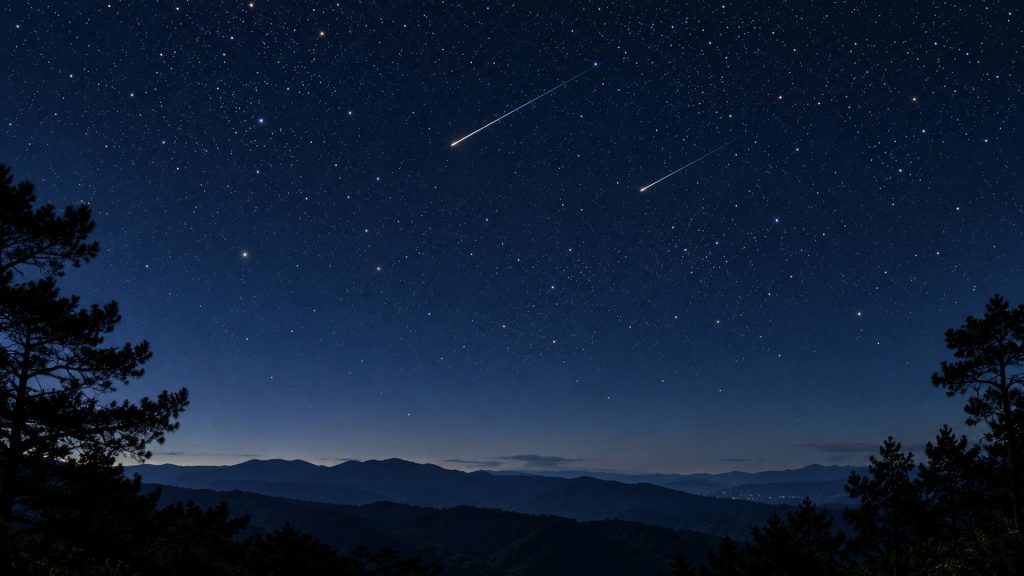
The Orionids are active from October 2 to November 7, with PAGASA placing the peak around October 21. Its diary lists a zenithal hourly rate, or ZHR, of 15. [1, 2]
ZHR is an idealised rate for a dark sky with the shower’s radiant overhead. It is not a promise that every observer will see 15 meteors in an hour. Clouds, artificial lighting, moonlight and a low radiant can reduce the number visible.
The shower comes from particles left behind by Comet 1P/Halley. As Earth crosses this debris trail, particles enter the atmosphere and produce brief streaks of light. Their paths appear to point back toward Orion, which gives the shower its name. Orion itself is not producing the meteors. [4]
PAGASA’s illustrated viewing time is about 4:00 a.m. on October 21, when the radiant is high in the sky. Its diary warns that the waxing gibbous Moon may interfere with observations. Moonlight matters while the Moon is above the observer’s horizon; local moonset and sky conditions also affect the available dark-sky window. [1, 2]
No telescope is needed. Use the naked eye and take in a broad area of sky rather than staring at a single star. NASA recommends observing after midnight, away from streetlights, and allowing roughly 30 minutes for your eyes to adjust to darkness. [4]
Leonis Minorids: a much quieter shower
The Leonis Minorid meteor shower is active from October 19 to 27, peaking around October 24. Its apparent point of origin is in Leo Minor. PAGASA suggests looking before dawn, with an illustrated viewing time near 5:00 a.m. [1, 2]
This is a weak shower. PAGASA’s calendar gives a ZHR of three, while its explanatory text says up to two meteors per hour under ideal conditions. Both figures indicate very low activity. A near-full Moon may further reduce sightings, so readers should not expect a busy display.
October’s Moon phases and changing distance
| Phase | Date and time | What it means |
|---|---|---|
| Last Quarter | October 3, 9:25 p.m. | Half of the visible disk is illuminated as the lit portion decreases |
| New Moon | October 10, 11:50 p.m. | The Moon’s illuminated side faces largely away from Earth |
| First Quarter | October 19, 12:13 a.m. | Half of the visible disk is illuminated as the lit portion increases |
| Full Moon | October 26, 12:12 p.m. | The visible disk is fully illuminated |
The exact Full Moon time occurs during the day. Readers can watch the nearly full Moon on the surrounding nights; the phase time is not a moonrise time. Around New Moon, reduced moonlight generally makes faint stars easier to see. [1, 2, 5]
The Moon’s orbit is slightly elongated. Perigee is its nearest point to Earth in an orbit, and apogee is its farthest point. October has perigees on October 2 and 29, with an apogee on October 17. These are regular orbital changes, rather than brief flashes or sudden visible events. [1, 2, 6]
Which planets are visible this month?
PAGASA’s diary places Venus and Mercury low in the western sky after sunset early in October, Saturn in the evening and nighttime sky, and Mars and Jupiter in the early-morning sky.
Its sample rise and set times show how the morning planets become available earlier as October progresses: Mars rises at 1:09 a.m. on October 1 and 12:23 a.m. on October 31, while Jupiter rises at 2:28 a.m. and 12:49 a.m. on those dates. Saturn’s listed setting time shifts from 6:09 a.m. following October 1 to 4:02 a.m. following October 31. [1, 2]
These are diary reference times, not exact predictions for every Philippine address. For a viewing plan in Baguio or elsewhere, use your actual location in a sky map and account for mountains, buildings and trees.
Constellations to watch in October
PAGASA’s sky chart for 9:00 p.m. on October 15 highlights Cepheus, Lacerta and Pegasus in the northern part of the sky, and Aquarius, Piscis Austrinus and Grus in the southern part.
For beginners, the Great Square of Pegasus offers a recognisable pattern. Its four corners are Markab, Scheat, Algenib and Alpheratz, with Alpheratz belonging to neighbouring Andromeda. Fomalhaut, a bright star in Piscis Austrinus, is another useful landmark. The fainter stars of Lacerta will be harder to distinguish where artificial light brightens the sky. [1, 2]
Constellations are patterns seen from Earth. Galaxies, nebulae and star clusters mentioned in the diary are separate observing targets; many require suitable equipment and will not resemble colourful photographs through the naked eye.
Astronomy activities begin the month
100 Hours of Astronomy runs from October 1 to 4, encouraging public participation in astronomy. PAGASA’s October press release announces a mini-workshop with Solar System activities for primary and secondary students, along with free planetarium shows and telescope viewing, subject to weather conditions. Readers interested in attending should obtain the specific schedule and participation arrangements from PAGASA. [2, 7]
World Space Week follows from October 4 to 10, an annual celebration of space science and technology. [8]
For inquiries about its astronomy activities, PAGASA lists [email protected] and (02) 8284-0800, local 3015, 3016 or 3017 in the October diary. These are PAGASA contacts, not an announcement of a Baguio viewing event. [2]
Practical reminders for skywatchers
- Check the weather close to your viewing time. A predicted astronomical event can occur even when clouds prevent anyone below from seeing it.
- Use a safe, open viewing area. Avoid roads, exposed slopes and places that are closed at night.
- Match the equipment to the target. Meteors suit naked-eye viewing; a telescope is useful for Saturn’s rings and planetary detail.
- Reduce glare. For meteor watching, keep bright screens and lights out of your line of sight.
- Dress for the conditions. In Baguio and other highland areas, prepare for cool air, damp surroundings and changing visibility.
- Plan around the horizon. A low western planet may disappear behind nearby terrain well before its calculated setting time.
Sources
- PAGASA: Astronomical Diary, October 2026
- PAGASA: October 2026 Astronomical Diary press release (PDF)
- NASA: Saturn observing guidance and opposition explained. Used for general observing explanations, not October 2026 dates.
- NASA Science: Orionids. Used for the shower’s origin and general viewing advice; this guide follows PAGASA’s Philippine peak-date guidance.
- NASA Science: Moon Phases
- NASA Science: The Moon’s Orbit
- IAU Office for Astronomy Outreach: 100 Hours of Astronomy
- World Space Week Association
For more information, see our complete guide on 800 Examinees Successfully Passed the 2020 Physician Licensure Examination.