

 By
By Baguio’s Heavy-Vehicle Ordinance: Required Checks, Escort Fees and Penalties
Excerpt: Baguio’s heavy-vehicle ordinance requires safety inspections and a 24-hour roadworthiness pass for covered vehicles. Here are the checks, escort charges, penalties, and road-safety reminders drivers should know.
Trucks and buses navigating Baguio’s slopes are covered by a city ordinance that requires vehicle safety checks and provides for traffic-enforcer escorts through hazardous sections.
City Ordinance No. 058, Series of 2026 applies to trucks, buses, and commercial vehicles with a gross weight exceeding 4,500 kilograms entering or operating within Baguio City, particularly on roads with gradients exceeding 10 percent.
Authored by Councilor Jose M. Molintas, the measure was passed on June 8, 2026, and approved by Mayor Benjamin B. Magalong on June 18, 2026. The official copy includes a certification of posting and publication.
For transport operators, the requirements concern the vehicle’s condition, the driver’s documents, and compliance with designated checkpoints. For other motorists and passengers, they are also a reminder to allow space for heavy vehicles and follow road restrictions.
Which Vehicles Are Covered?
The ordinance’s weight threshold is more than 4,500 kg, or 4.5 metric tons. Its scope covers trucks, buses, and commercial vehicles entering or operating within the city.
A road gradient above 10 percent means a road rises or falls by more than 10 meters over 100 meters of horizontal distance.
The ordinance’s scope is within Baguio City. Separate restrictions issued for access roads in Benguet, La Union, or Mountain Province must also be checked. A city roadworthiness pass should not be treated as permission to disregard a road closure or vehicle restriction.
What Inspectors Will Check
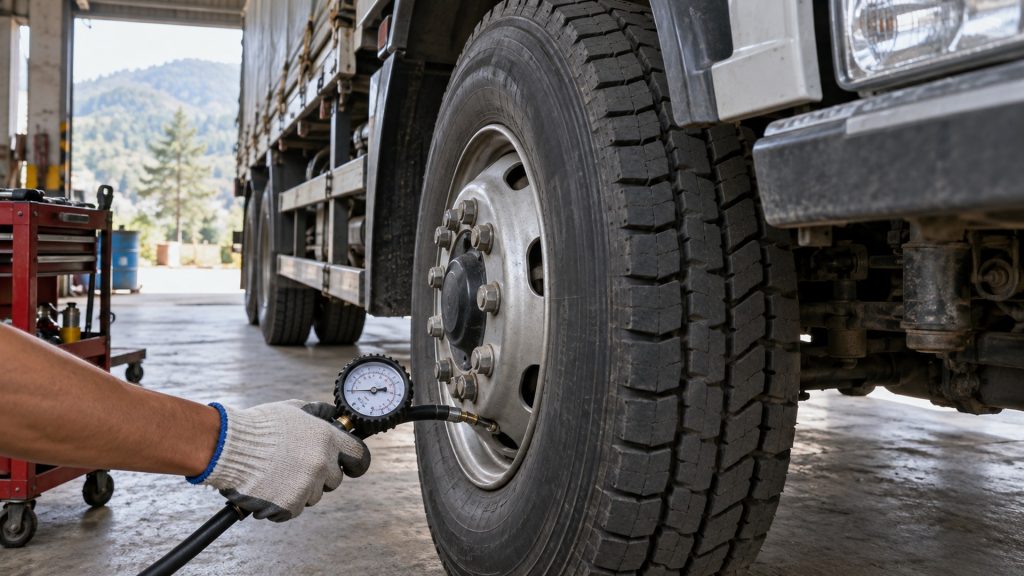
The ordinance provides for designated checkpoints at Marcos Highway and Kennon Road, staffed by personnel from the City Engineering Office, Public Order and Safety Division, and Baguio City Police Office.
Drivers must present:
- Valid vehicle registration
- A valid driver’s license
- Proof of insurance
Vehicles must undergo the following checks:
| Component | Requirement under the ordinance |
|---|---|
| Brakes | Pedal responsiveness and hydraulic-system integrity |
| Tires | Minimum tread depth of 3 mm, with no visible cracks or bulges |
| Lights | Working headlights, taillights, brake lights, and turn signals |
Vehicles that pass inspection are to receive a roadworthiness pass valid for 24 hours. Operating without the pass is subject to immediate apprehension.
Vehicles that fail inspection are to be denied entry until an accredited mechanic certifies the repairs. Operators should confirm the current checkpoint arrangements with the implementing offices before dispatching a covered vehicle.
When an Escort May Be Required
Drivers unfamiliar with steep terrain may request, or may be required to accept, a traffic-enforcer escort through hazardous zones.
The ordinance identifies Marcos Highway’s “Breathe” section and Kennon Road’s zigzag segment as examples. It also provides for dedicated city escort motorcycles or vehicles separate from the police office’s regular patrol fleet.
How Much Is the Escort Charge?
The ordinance sets gasoline-expense reimbursement at:
- ₱500 for the first four kilometers
- An additional ₱50 for every succeeding two kilometers
It expressly ties payment to an escort service actually provided and describes reimbursement as recovery of the actual, reasonable service cost, including fuel and necessary operational expenses.
Treasury personnel must issue official receipts. Payment is required immediately or before the release of an impounded vehicle.
Penalties for Violations
The ordinance sets different penalties for failing to report to checkpoints and operating an unsafe vehicle.
Failure to Report to Checkpoints
| Offense | Penalty |
|---|---|
| First | ₱1,000 fine |
| Second | ₱3,000 fine and a mandatory four-hour safety seminar |
| Third | ₱5,000 fine and vehicle impoundment until fees and fines are settled |
Operating a Non-Roadworthy Vehicle
| Offense | Penalty |
|---|---|
| First | ₱2,000 fine and impoundment until repairs are certified |
| Second | ₱3,500 fine and a mandatory six-hour vehicle safety seminar |
| Third | ₱5,000 fine and a 30-day business-permit suspension, if applicable |
The measure also provides for free quarterly seminars on steep-terrain navigation, gear usage, and vehicle maintenance, organized by the City Engineering Office in coordination with POSD.
Practical Safety Reminders on Steep Roads
These general driving reminders complement the ordinance’s requirements:
- Check the vehicle before departure. Have competent mechanics inspect brakes regularly. Check tires, lights, and other safety equipment.
- Control downhill speed. LTO guidance warns that excessive braking on descents can contribute to brake problems. Follow the vehicle manufacturer’s instructions for appropriate gear use.
- Leave enough space. Avoid tailgating and allow room to react, particularly when following trucks and buses.
- Avoid unsafe overtaking. Observe no-passing markings and work-zone restrictions. Do not attempt to pass where a curve or crest blocks the view.
- Adjust to fog. Slow down and use low-beam headlights. If visibility becomes unsafe, stop at a safe location clear of moving traffic.
- Follow personnel on site. Wait for directions at controlled sections rather than forcing passage.
Passengers can help by wearing available seat belts and avoiding requests that pressure drivers to speed or overtake.
Sources and Official Resources
- Baguio City Council: Ordinance No. 058-2026, including approval and posting certification. Sections 2–6 contain the scope, inspection requirements, escort reimbursement, penalties, and safety education provisions.
- Land Transportation Office: Filipino Driver’s Manual, Volume 1, Second Edition. Driving fundamentals and road safety.
- Land Transportation Office: Comprehensive Driver’s Education road-safety material. Brake maintenance, driving habits, and poor visibility.
For more information, see our complete guide on List of Open Establishments, Operating Hours and Mode of Service.