

 By
By Are We Walking Through Clouds? Understanding Baguio’s Fog
Fog can turn a familiar Baguio street into a hazy scene. Here is what surrounds us, why it changes, and how it differs from mist and drizzle.
It is a familiar Baguio experience: buildings across the street lose their sharp outlines, pine trees fade into a pale background, and a view you know well becomes harder to make out. Whether remembered from an evening walk or a morning commute, it raises a question: are we walking through clouds?
Yes. When we are surrounded by fog, we are inside a cloud touching the ground. PAGASA defines fog as water droplets suspended in air at the earth’s surface. The difference from a cloud overhead is where we encounter it.[1]
What surrounds us when it is foggy?
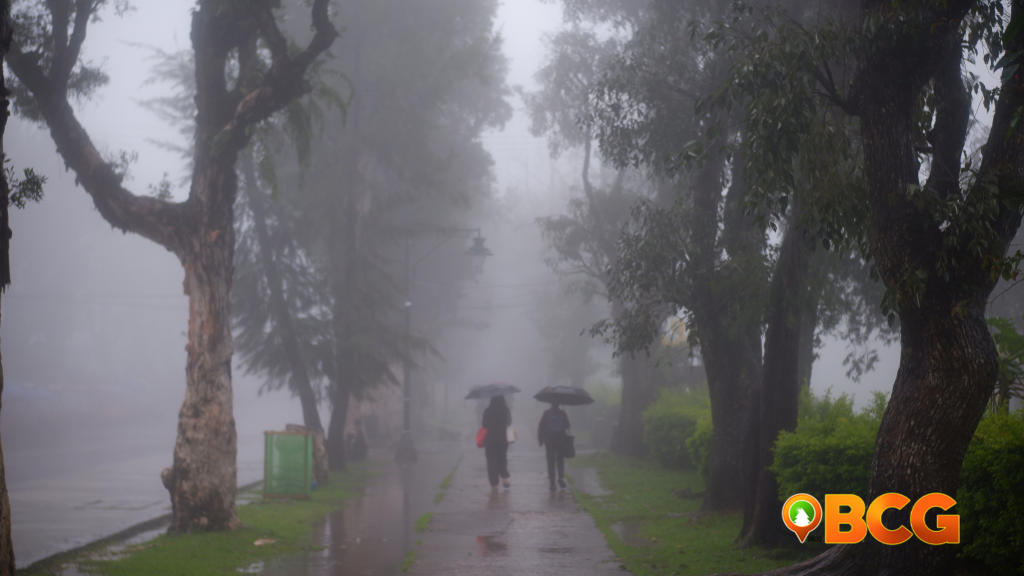
The whiteness is a collection of tiny liquid water droplets. Water vapor itself is an invisible gas. It becomes visible when it condenses into droplets, which together form a cloud.[2]
Those droplets are small enough to remain suspended in the air. That explains how fog can surround buildings, trees, and people without behaving like falling rain. A cloudy-looking street does not automatically mean it is raining.[1,2]
How moisture, cooling, and mountains work together

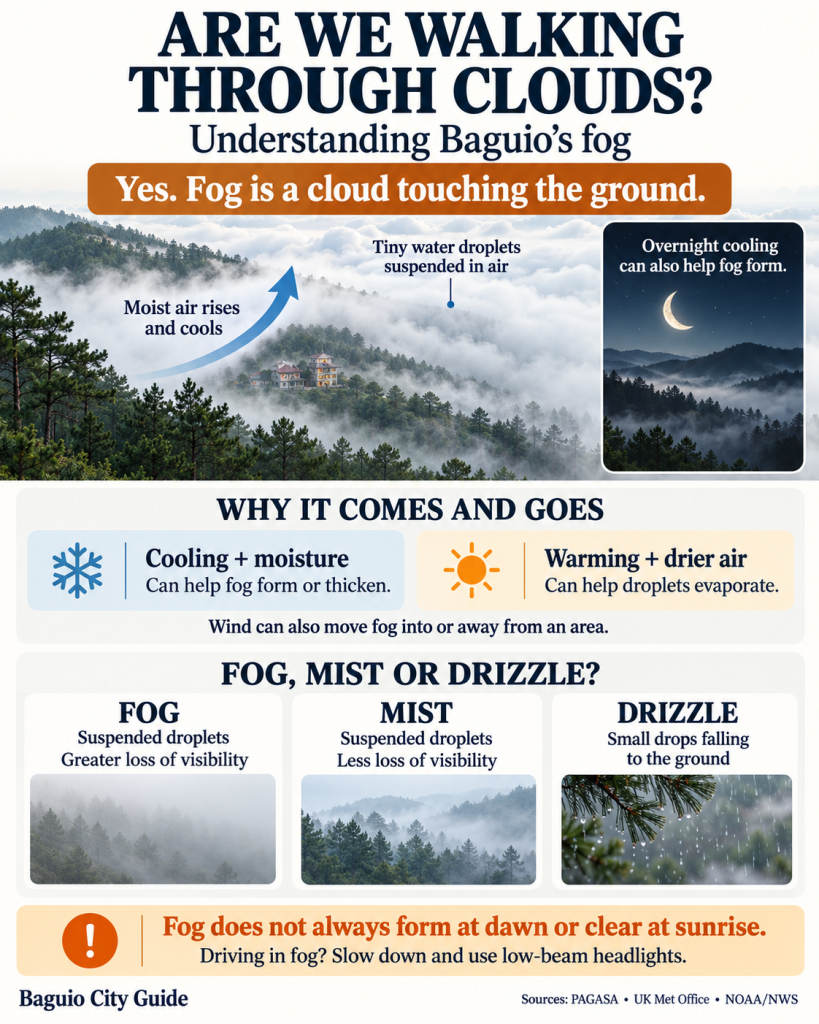
Fog needs moisture and conditions that allow droplets to form. One important route is cooling. As moist air cools sufficiently, it reaches saturation, the point at which water vapor can begin condensing into liquid droplets.[2]
The dew point is the temperature at which condensation begins as air cools under ordinary conditions. It depends on the air’s moisture content, so cold weather alone does not guarantee fog.[1]
At night, the ground can lose heat and cool the air immediately above it. With sufficient moisture and suitable wind conditions, this can produce radiation fog. The name refers to heat escaping from the surface, rather than anything radioactive.[3]
Mountains provide another route. Wind can push moist air uphill. As that air rises, it cools, allowing condensation and potentially producing upslope fog.[2,3]
PAGASA identifies Baguio’s elevation as about 1,500 meters in its climate overview.[4] At elevated ground, a cloud layer can meet a hillside instead of remaining above it. A cloud seen overhead from lower ground can therefore be fog to someone standing within it higher up.[5]
These processes explain how fog can occur in a highland setting. They do not establish the cause of every Baguio fog event. Identifying a particular event would require local weather observations, rather than judging from its appearance alone.
Why fog thickens, thins, or disappears
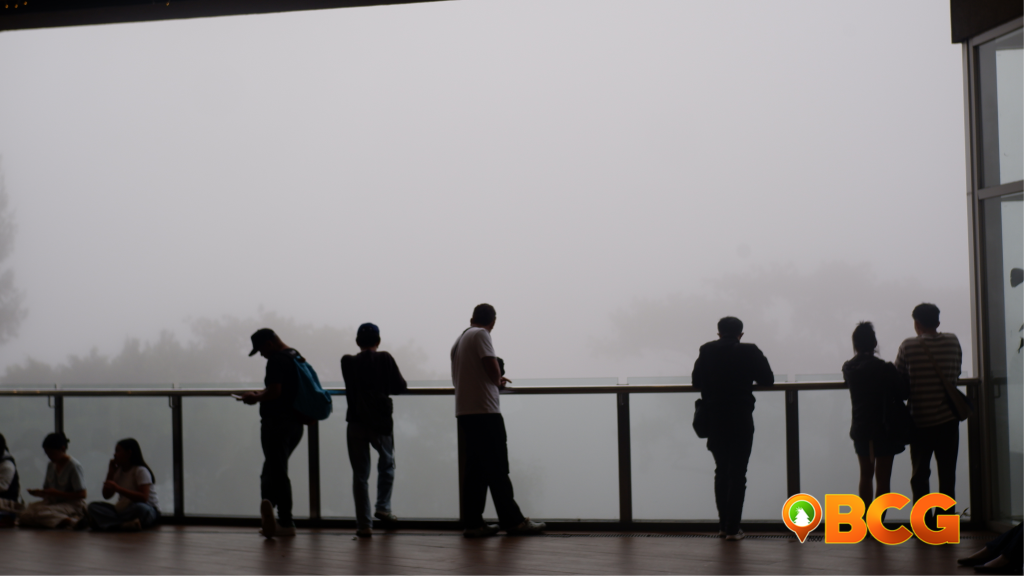
Fog changes as temperature, moisture, and airflow change. Continued cooling or additional moisture can help sustain condensation. If conditions become less favorable for droplets to remain, the fog can thin.[6]
Warming can encourage droplets to evaporate back into invisible water vapor. Mixing with drier air can also help clear fog. Wind may move a fog bank into or away from a location, so a changing view does not necessarily mean all the droplets have evaporated.[5,6]
Sunlight warming the ground often helps radiation fog dissipate. However, sunrise is not an automatic clearing signal, and fog does not have to begin at dawn. Different formation processes and weather conditions produce different timing.[3]
A clearer view may also mean fog has lifted into a low cloud layer. The air at street level becomes clearer while cloud remains overhead.[6]
Fog, mist, and drizzle are different
Fog and mist both consist of water droplets suspended in air. Their meteorological distinction centers on visibility: fog reduces horizontal visibility to less than one kilometer, while PAGASA describes mist as thinner fog with visibility greater than one kilometer.[1,3]
Drizzle falls. PAGASA defines it as precipitation made up of very small water drops. Unlike the suspended droplets of fog, drizzle drops fall to the ground. PAGASA also notes that stratus, a low cloud layer, can produce drizzle.[1,2]
The practical distinction is between droplets surrounding you and drops falling on you. Similar-looking gray weather can involve different conditions.
What reduced visibility means for everyday life
For someone heading to work, taking children to school, or driving home, fog’s immediate effect is a shorter clear view. Familiar road features, vehicles, and people can become harder to see.[3,7]
The US National Weather Service advises drivers in fog to slow down, leave more distance behind the vehicle ahead, and use low-beam headlights. High beams can create glare that makes the road harder to see.[7]
Walking through a cloud is a scientifically accurate description of being in fog. Understanding it also explains why a familiar Baguio view can change as the air around us changes.
Sources
- PAGASA. Meteorological Terms, entries for Fog, Dew point, Mist, and Drizzle. pagasa.dost.gov.ph
- PAGASA. Clouds. pagasa.dost.gov.ph
- UK Met Office. What is fog?. Met Office
- PAGASA. Climate of the Philippines. pagasa.dost.gov.ph
- NOAA National Weather Service. What are Marine Layer Clouds and How Do they Form?. Used for general cloud, terrain, movement, and evaporation principles; its California setting is not presented as a Baguio diagnosis. weather.gov
- NOAA National Weather Service. Fog Ingredients. weather.gov
- NOAA National Weather Service. Driving in Fog.